How Much Does a Website Redesign Cost in the UK?
UK website redesign costs with real figures: when a refresh beats a rebuild, what drives the price, and how to keep your SEO intact through the changeover.
Budget £1,500-£5,000 for a UK visual refresh, £5,000-£20,000 when structure and templates change for a small-to-mid business, £15,000-£60,000 for most serious B2B rebuilds, and £60,000+ when you replatform a complex corporate or multi-site estate. Ecommerce and integration-heavy rebuilds often sit in the £10,000-£40,000 band before enterprise scope pushes higher. Those figures are UK market ranges across freelancers and agencies - templates, CMS depth, content volume and SEO migration quality move your quote.
The short answer: what a redesign costs
| Shape | Typical UK market range | What it usually means |
|---|---|---|
| Visual refresh | £1,500-£5,000 | New look on existing structure and platform; limited IA change |
| Small business redesign | £5,000-£15,000 | New templates, clearer journeys, CMS tidy-up, basic migration |
| Mid / B2B redesign | £15,000-£60,000 | Deeper IA, component system, integrations, proper SEO cutover |
| Ecommerce redesign | £10,000-£40,000+ | Catalogue, checkout, redirects, performance under product weight |
| Replatform / enterprise | £60,000-£150,000+ | New CMS or stack, multi-site, heavy governance, phased cutover |
Freelancer jobs cluster toward the left; larger London agencies toward the right. A cheap number that skips redirect mapping and Harden is not a bargain - it is a ranking time-bomb.
Our own redesign work is quoted as a fixed price once the work is scoped, with any changes priced before we do them, and agentic delivery holding comparable implementation at roughly half a traditional bench cost. We rebuilt our public site as the worked example of doing this in public. Sibling pricing context: website development cost UK for new builds from scratch, website maintenance cost for the retain-vs-redesign call, and CRO when the issue is conversion rather than aesthetics.
Why redesign quotes scatter so widely
Two agencies can see the same homepage and price different jobs.
One prices a skin: new fonts, new hero, same templates, same CMS, hope. The other prices a product change: IA, component system, migration, integrations, SEO cutover, training. Both get called “redesign” on the invoice. Only one matches what most B2B buyers actually need when conversion is flat and editors are scared to publish.
That is why market ranges look wide. The word is overloaded. Force the shape label - refresh, rebuild, replatform - before you compare numbers. If a proposal cannot say which shape it is, make them rewrite it.
Freelancers win fair refresh work. Specialist agencies win rebuilds with migration risk. Large houses win governance-heavy estates. Hire the shape, not the brand halo.

Refresh, rebuild or replatform: how to tell which you need
Refresh when brand tokens are tired but IA still matches how you sell, the CMS is tolerable, and analytics show usable journeys. You are buying design system application and polish, not a new product.
Rebuild when templates fight every campaign, key journeys bounce for structural reasons, or content modelling cannot express what you sell. Same domain, new information architecture and components - often on the same platform if the platform is fine.
Replatform when the CMS or stack is the constraint: upgrade hell, plugin debt, performance ceilings, or editorial workflows that need a different model. Replatform without an IA rethink just moves the mess.
Decision signals we’ve used across 350+ projects since 2005:
- Conversion leak is element-level (form friction, proof, speed) → try CRO and maintenance first
- Conversion leak is structural (wrong pages, confusing nav, content model fights the offer) → redesign
- Ops cannot edit safely or deployments scare everyone → rebuild or replatform
- Multi-brand sprawl → design system + shared kit (we have shipped 100+ branded sites in one rollout pattern when the kit is real)
Do not buy a redesign to avoid writing clearer offers. Pretty confusion still converts poorly.
What drives redesign cost
Four drivers dominate the price.
1. Content volume and migration. Hundreds of URLs mean redirect maps, canonical decisions and “what dies quietly” calls. Agents accelerate bulk transforms; humans still decide which pages earn a 301. Under-budgeted migration is the classic reason a “simple redesign” slips a quarter.
2. CMS depth. Thin marketing CMS stays cheap. Draft/review/schedule workflows, roles, localisation and preview are product work. If three editors need “edit anything”, say so early and keep the model thin.
3. Integrations. CRM, booking, ERP, live chat, payment, SSO. Each trustworthy integration adds discovery and Harden time. A redesign that “keeps the same HubSpot form” is still an integration test, not a freebie.
4. SEO migration seriousness. Redirects, metadata, structured data, XML sitemaps, internal links, and parity checks on money landing pages. Agencies that treat SEO as a launch-week plugin install are why redesigns get blamed for traffic loss.
Secondary drivers: design ambition (motion, illustration, custom art direction), accessibility debt you choose to clear properly, and stakeholder count. Five approvers with no decision owner inflate calendar more than adding a template.
| Driver | Lower band | Higher band |
|---|---|---|
| Content | Tens of pages, clean inventory | Hundreds of URLs, messy legacy |
| CMS | Light editorial | Workflows, roles, multi-locale |
| Integrations | Forms + analytics | CRM/ERP/booking/payments |
| SEO cutover | Few money URLs | Large index, many landing pages |
| Design | System application | New visual language + motion |
The SEO migration bit agencies get wrong
Redesigns do not kill rankings by magic. Sloppy cutovers do.
Redirects. Old money URLs need deliberate 301s to the best new equivalent - not a blanket homepage dump. Soft 404 patterns and redirect chains leak equity and confuse crawlers.
Parity on intent. If /services/marketplace-development was a ranking page, the new IA still needs a page that answers the same intent with equal or better substance. Renaming everything for brand poetry without intent mapping is vanity.
Schema and metadata. Titles, descriptions, FAQ/HowTo where genuine, Organisation consistency. Stripping structured data “temporarily” is how temporary becomes permanent.
Internal links and nav. Orphaned case studies and blog spokes lose crawl attention. Redesign is a chance to fix link equity flow - or to break it.
Measurement. Baseline rankings, converting landing pages, and Core Web Vitals before you touch DNS. Without a baseline, every dip becomes an argument.
Content quality. A thinner page with prettier CSS is still a thinner page. If you cut 40% of the words that earned citations, do not blame Google for noticing.
We treat SEO migration as in-scope Harden work on redesigns, not as an optional extra after marketing has already celebrated the new homepage.
How we scope a redesign
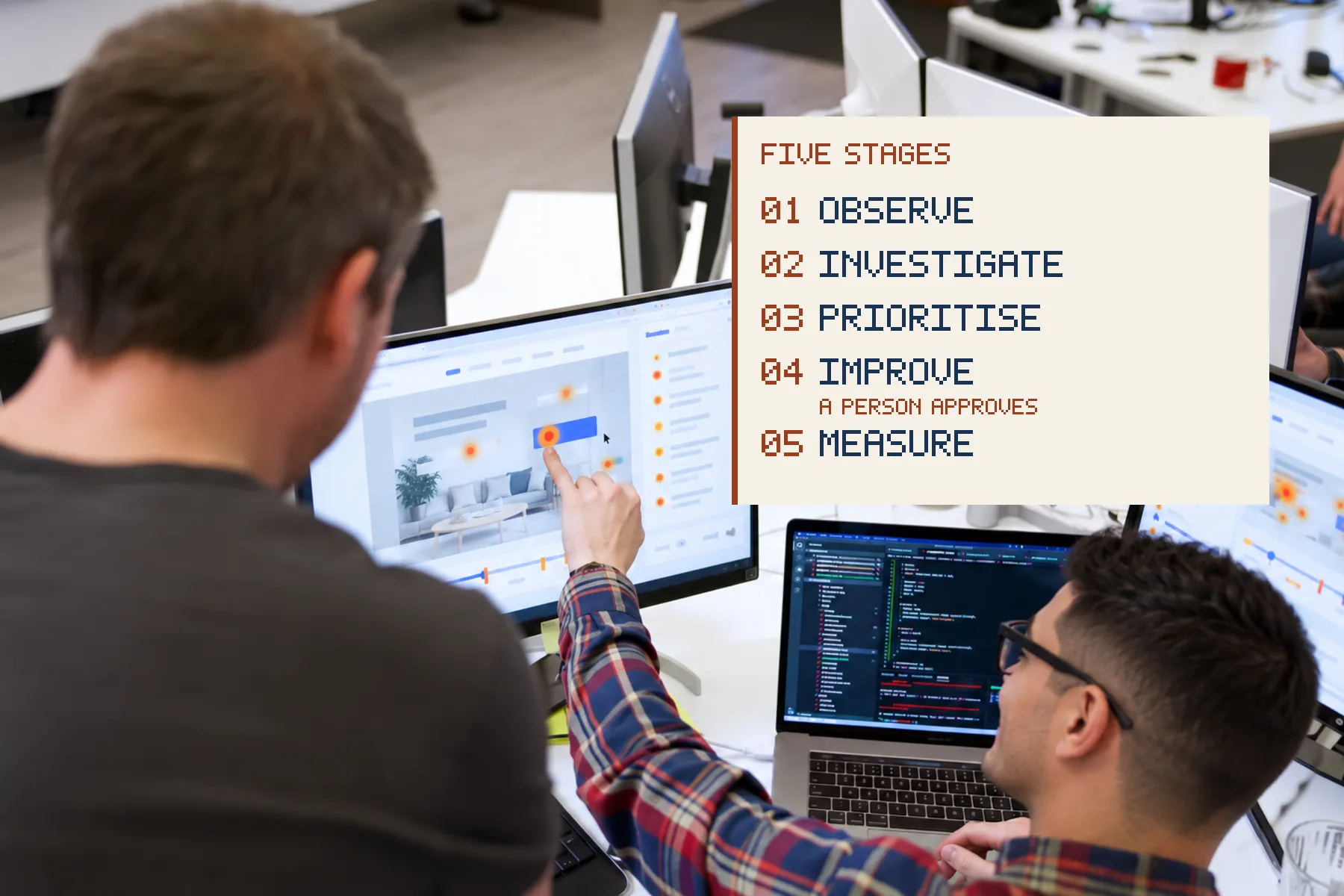
Audit first. Analytics, search console, IA, CMS pain, accessibility, performance, and who already ranks for the terms that matter to your pipeline. When the brief is fuzzy, a UX audit is the cheaper diagnostic before anyone redraws the entire site.
Map the commercial problem. Are we fixing trust, conversion, editorial speed, technical debt, or brand refresh for its own sake? Rank the jobs. A redesign that tries to solve five jobs without priority becomes a reboot nobody can finish.
Blueprint: agree a fixed price. Templates, migrations, integrations, SEO cutover plan, acceptance checks. Anything outside that scope is priced separately before we do it. Agentic delivery compresses implementation once the system is coherent - seniors direct agents; humans own release.
Build against a design system. Components over one-off page paintings. That is how later Evolve work stays affordable.
Harden, then Launch. Redirect QA, accessibility, performance budgets, form tests, staging approval. 90-day warranty on the project scope. After that, many clients sit on Support & Growth at £495 / £1,850 / £3,450 rather than waiting for the next emergency redesign.
Our own 2027 rebuild followed that path: entity-consistent facts, question-shaped pages, service hubs that match how we sell, and a public willingness to show agent-assisted delivery rather than hide it. Est 2005 did not make us skip Harden - it made us refuse to.

"After four years, my business website needed a refresh and I turned to Code23. They were full of great ideas, helpful and patient, turning my requests and ideas into something tangible. I’m incredibly happy with the end result and wouldn’t hesitate them to anyone looking for web design support."
Content inventory before anyone designs
Most redesign overruns start as content surprises.
Run this inventory in Map, not in week six of Build:
- URL export from the CMS and Search Console - what exists, what earns clicks, what converts
- Keep / merge / kill decisions with a named owner on your side
- Redirect targets for every keep/merge URL that will change path
- Ownerless pages - orphan blogs, old campaign landers, PDF graveyards
- Legal and compliance pages that must survive cutover day
- Embedded third parties - chat, booking, tag managers, pixel debt
Agents can help cluster near-duplicate pages and draft redirect tables. Humans still decide which story the business wants to keep telling. If marketing cannot staff content decisions, price delay into the plan or shrink scope. Pretending content will “catch up after launch” is how soft launches become permanent.
Redesign vs maintain vs CRO
Three different cheques:
- Maintenance keeps a healthy site healthy - patches, monitoring, small fixes. See website maintenance cost.
- CRO fixes measurable leaks inside a structure that mostly works. See conversion rate work.
- Redesign changes structure, templates or platform when the frame itself is wrong.
Buying a redesign because the contact form is unclear is a waste. Buying CRO when the IA cannot express your offer is denial. After 350+ projects we would rather lose a redesign sale than take one that should have been a form rewrite. The cheapest redesign is the one you correctly decline.
What a redesign quote should list
If these lines are missing, ask for them before you compare prices:
- Template / component count
- CMS and editorial workflow in or out
- Content migration volume and redirect ownership
- Integrations named with test responsibility
- SEO cutover checklist and who signs it
- Accessibility and performance budgets
- Staging, training and launch support
- Warranty and post-launch support path
- Hourly rate for extras (on our builds, every extra is priced before we do it)
A fixed price agreed up front beats a floating estimate that grows every time someone remembers a microsite. On our project work the payments are staged against milestones rather than the calendar, and everything we ship carries a 90-day warranty on defects within spec. That commercial clarity belongs on redesigns as much as on brand-new sites - the migration risk is why.
How much does it cost to redesign a website?
In the UK, most redesigns land between £5,000 and £60,000 depending on whether you need a refresh, a structural rebuild or a full replatform, with visual-only refreshes starting around £1,500-£5,000 and complex estates rising past £60,000.
How much does it cost for someone to update your website?
Small content and design updates are often retainer work from a few hundred pounds a month upward; a true redesign is a project fee in the thousands because structure, templates and migration are in play - not a “quick update”.
How much can I charge for a website redesign?
Freelancers commonly charge from low thousands for refreshes into the mid-teens for fuller redesigns, while agencies price higher against team overhead and assurance - price the migration and SEO cutover explicitly or you will undercharge.
Is web design still worth it in 2026?
Yes, when the site is a sales and trust surface: clarity, speed and proof still move revenue even as AI assistants influence discovery - a redesign is worth it when structure or brand trust is the bottleneck, not when you only needed copy and CRO.
A redesign is a bet that structure and trust are worth more than another round of button tweaks. Price the migration and the SEO cutover like adults, keep the shape label honest, and you will know whether the market range you land in is a refresh, a rebuild or a replatform - not a surprise.
Refresh, rebuild or replatform - label the job before you fund the Figma file.
Frequently asked questions
What’s the difference between redoing a website and a full redesign?
“Redo” usually means one of the shapes in the table above: a visual refresh on the same structure, or a rebuild that changes the information architecture and templates. The two cost very differently, because one is design work and the other is a structural change with migration and testing behind it. Tell us what’s actually broken and we’ll tell you straight which one you need.
How much does a B2B website redesign cost in the UK?
It sits in the Mid / B2B band in the table above, and the real driver isn’t the brand work, it’s what’s underneath: integrations with your CRM or ERP, content volume, and how seriously the SEO cutover is planned. Two B2B sites that look similar on the surface can carry very different quotes once those are priced properly. Ask for that breakdown before you compare numbers.
Does a website refresh cost less than a rebuild?
Almost always, because a refresh reuses your existing structure and platform while a rebuild changes the information architecture, templates and often the migration behind it. The bands in the table above show why the gap is so wide. If your IA still matches how you sell, don’t pay for a rebuild you don’t need.
Next step
If you’re staring at a “redesign” quote and can’t tell whether it’s for a skin, a rebuild or a full replatform, that’s the first question to answer, not the last. Get the shape right and the price makes sense. Get it wrong and you’ll pay twice.
Our Discovery Sprint scopes your redesign properly: the shape, the drivers, the migration risk and a fixed price you can take to the board, credited in full against the build if you go ahead. We’ve delivered 350+ projects since 2005, so we know what each option costs in practice.
Get cost certainty
Get a fixed price before the build starts.
We’ll discuss what you need, then get back to you with a clear price and timescale within 48 hours.