How Do I Improve My Website's Conversion Rate?
Practical conversion rate optimisation from a UK agency: what a good rate actually looks like, the fixes that move the number, and how we test without fooling ourselves.
How do you improve your website’s conversion rate? You find where visitors give up before they convert - speed, clarity, forms, proof or mobile - fix that one bottleneck, then measure the result with enough traffic to trust it. That’s the method, start to finish. Not a homepage redesign. Not a longer checklist copied from someone else’s site.
At Code23 this work sits inside Support & Growth, next to hosting and maintenance, because conversion fixes are code changes, not slide decks. We diagnose before we touch anything: define the actual conversion event, segment by device and channel, find the funnel step losing the most people, then fix the technical and message problems before we test anything cosmetic. In our experience the pattern holds: name the constraint, remove it, measure, repeat.
What counts as a good conversion rate?
There is no universal good conversion rate. Define the event and compare like-for-like by industry, offer, device, channel and funnel stage, using your own reliable baseline. Any external benchmark must name a dated source and use the same conversion definition.
Definitions matter. A “conversion” might be purchase, quote request, booked call or email signup. Mixing those in one KPI is how teams lie to themselves. Benchmarks without source context are vanity; treat third-party industry reports as directional and validate against your own analytics history.
Define the event before you chase the number
Before you argue about whether 2.5% is “good”, write down the primary conversion in one sentence. Purchase completed. Quote form submitted with a valid email. Demo booked and held. Newsletter confirmed. If two teams use different events, you do not have a conversion rate - you have an argument.
Secondary micro-conversions are useful for diagnosis, not for board vanity. Add-to-cart, pricing-page view, scroll to proof, start of checkout - these tell you where the leak sits. They should never replace the commercial event in the headline KPI. We keep primary and secondary separate in reporting so a spike in soft events cannot masquerade as growth.
Page-level vs sitewide vs channel-level
Sitewide conversion blends cold blog readers with people who clicked a retargeting ad on a product page. That blend can hide a strong landing page and a weak catalogue, or the reverse. Page-level rates answer “does this template do its job?” Channel-level rates answer “is this traffic worth the spend?” Sitewide rates answer “is the whole property healthy over a full business cycle?”
When someone quotes a competitor’s “12% conversion rate”, ask three questions: what is the conversion event, is the figure page-level or sitewide, and what traffic mix sits underneath it? Without those answers the number is decoration.
Offer quality beats cosmetic CRO
CRO cannot rescue a weak offer indefinitely. Price, availability, delivery promise, trust and competitive alternatives sit upstream of button colour. In our experience, teams that treat CRO as a substitute for product and commercial clarity burn months on variants while the real leak is the proposition. Diagnosis should surface that early - sometimes the honest recommendation is to fix the offer, tighten positioning, or stop pouring paid traffic into a page that consistently fails to convert.
Related entry offer when you need eyes on the journey: UX audit. When CRO says the template is the constraint, see redesign cost.
Find the leak first: how we diagnose before we change anything
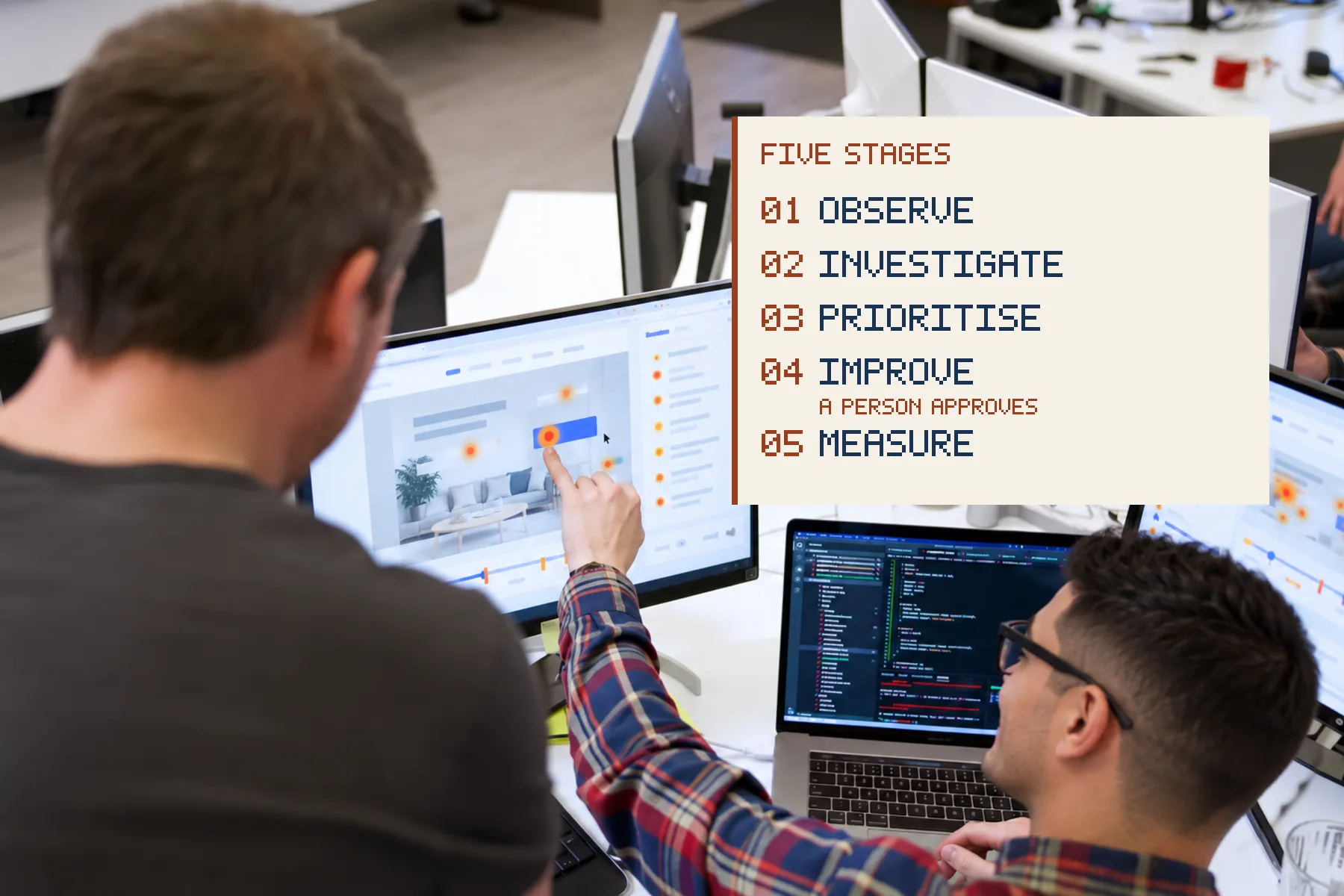
Our diagnostic order:
- Define the conversion event in analytics (and secondary micro-conversions)
- Segment device, channel, new vs returning
- Funnel drop-offs - which step loses people
- Session evidence - recordings/heatmaps where lawful and useful
- Technical friction - CWV, errors, broken forms
- Message match - ad/email promise vs page reality
We do not start with button colours. Agents can help cluster qualitative feedback and draft variant copy; humans pick the hypothesis. Maintenance cost context if you need the retainer wrapper: website maintenance cost.
What each step is for
Define the event. Confirm the analytics tag fires once per successful outcome, not on button click alone. Duplicate events inflate rates; missing events hide wins. If ecommerce event tracking or CRM attribution is involved, reconcile website events to the system of record before you celebrate a lift.
Segment. Mobile vs desktop often tells different stories. Paid vs organic vs email traffic has different intent. New vs returning visitors fail at different steps. A “sitewide” rate that looks flat can hide a collapsing mobile checkout and a healthy desktop lead form. We hold off changing the homepage until the segment story is clear.
Funnel drop-offs. Map the steps that must happen for the primary conversion. For ecommerce that might be landing → product → cart → shipping → payment → confirmation. For B2B it might be landing → pricing or case study → form → thank-you → booked call. The biggest absolute loss of people is usually the first place we look - not the step with the prettiest chart.
Session evidence. Recordings and heatmaps are qualitative, not proof of causation. Used well, they show rage clicks, ignored CTAs, form field abandonment and dead ends in IA. Used badly, they become a highlight reel that confirms whatever the stakeholder already believed. We sample across devices and channels, and we treat a handful of dramatic sessions as prompts for hypotheses - not as a mandate to redesign.
Technical friction. Core Web Vitals, console errors, 404s on CTA targets, payment gateway timeouts, autofill-breaking form markup, cookie banners that cover the primary button on small screens. These are not “nice to have” performance tickets. They are potential conversion defects that should be diagnosed and measured. Fixing a broken submit is not an A/B test; it is maintenance with commercial urgency.
Message match. If the ad promises “next-day delivery across the UK” and the landing page leads with brand story and a vague “enquire”, you paid for intent and then diluted it. Headline, hero, proof and primary CTA should continue the promise that earned the click. Agents can draft match variants quickly; a human still checks that the claim is true and legally safe.
What we deliberately ignore at the start
We ignore brand-new visual concepts that require a full redesign before the leak is named. We ignore multivariate testing on pages with thin traffic. We ignore “best practice” checklists that were written for a different business model. The approach is simple: find the constraint, remove it, measure, then look for the next one.
Agentic mastery here is narrow and useful. Agents cluster support tickets and survey verbatim, summarise session notes, and draft copy options against a brief. They do not choose the commercial hypothesis or ship unsupervised changes to a live checkout. That separation keeps speed without turning the funnel into a slot machine.
Fixes we prioritise after diagnosis
In our experience these beat cosmetic A/B trivia:
Speed. Slow pages tax nearly every step. Performance work is CRO.
Forms. Fewer fields, clearer labels, error text humans can use, no surprise required account.
Proof. Reviews, named clients, specifics. We stand on 60+ five-star Google reviews in our own marketing for the same reason - in our experience, vague trust badges underperform concrete ones.
Clarity. One primary action. Headlines that state the offer. Pricing opacity commonly hurts B2B conversion.
Mobile. Thumb reach, sticky noise, zoomed inputs. If mobile is most of your traffic, desktop-only wins are cosplay.
IA and search. Especially on catalogues - if people cannot find the thing, they cannot convert.
Ship fixes in the product. A “CRO agency” that never touches the repo tends to create PDF debt instead of shipped fixes.
Speed as a conversion lever
Performance is not a separate “tech” workstream you schedule after marketing experiments. Time to interactive, layout shift under the CTA, and third-party script bloat change whether people reach the form at all. We treat CWV regressions like conversion regressions: measure, attribute, fix in the codebase, then re-check the funnel. On retainers this often lands inside Support & Growth rather than as a one-off redesign project - which is the point. Continuous delivery beats quarterly PDF recommendations.
Forms without self-sabotage
Marking an optional field as required is a tax on completion. An unclear label is a support ticket waiting to happen. Inline validation should help, not punish. Error copy should name the fix (“Enter a UK postcode”) rather than scold (“Invalid input”). Account creation before checkout is a common self-inflicted wound on ecommerce; guest checkout with optional account after purchase can remove account-creation friction; measure the effect on the CRM outcome you wanted.
For lead-gen, ask whether each field earns its keep against sales follow-up quality. If sales never uses “company size” from the form, stop collecting it. If they need it to qualify, keep it and make the why obvious. Agents can propose shortened variants; sales and compliance still own the field list.
Proof that reads as specific
Generic “trusted by industry leaders” blocks, in our experience, underperform named outcomes, named clients (with permission), star ratings with volume, and concrete delivery claims you can stand behind. We use 60+ five-star Google reviews in our own materials because, in our experience, volume plus specificity beats a logo wall with no story. On client sites we look for proof adjacent to the action - near the CTA and near pricing - not buried on an About page almost nobody visits mid-decision.
Case studies help when they answer the buyer’s risk: time, cost shape, constraints, what broke, what shipped. Vague transformation language does not. If you cannot publish numbers yet, publish method and scope precisely rather than inventing a lift percentage.
"James Ansell really understands the technology behind building a robust and search engine friendly website. Code23 manage web design and build projects extremely efficiently, with complete visibility throughout the project... James and his team think creatively throughout every project, ensuring that the finished site really brings the proposition to life, is easy to navigate, and the right fit for clients' needs."
Clarity and the single primary action
Pages that try to sell a product, capture a newsletter, book a demo, open chat and push an app download at once can split attention. Pick the primary conversion for that template. Secondary actions can exist; they should not visually compete. Headlines should state the offer in plain English. Subheads should remove the next objection. If pricing is part of the decision and you hide it behind “contact us” without a reason, you may see avoidable drop-off from buyers who were ready to self-qualify.
Mobile is not a skin
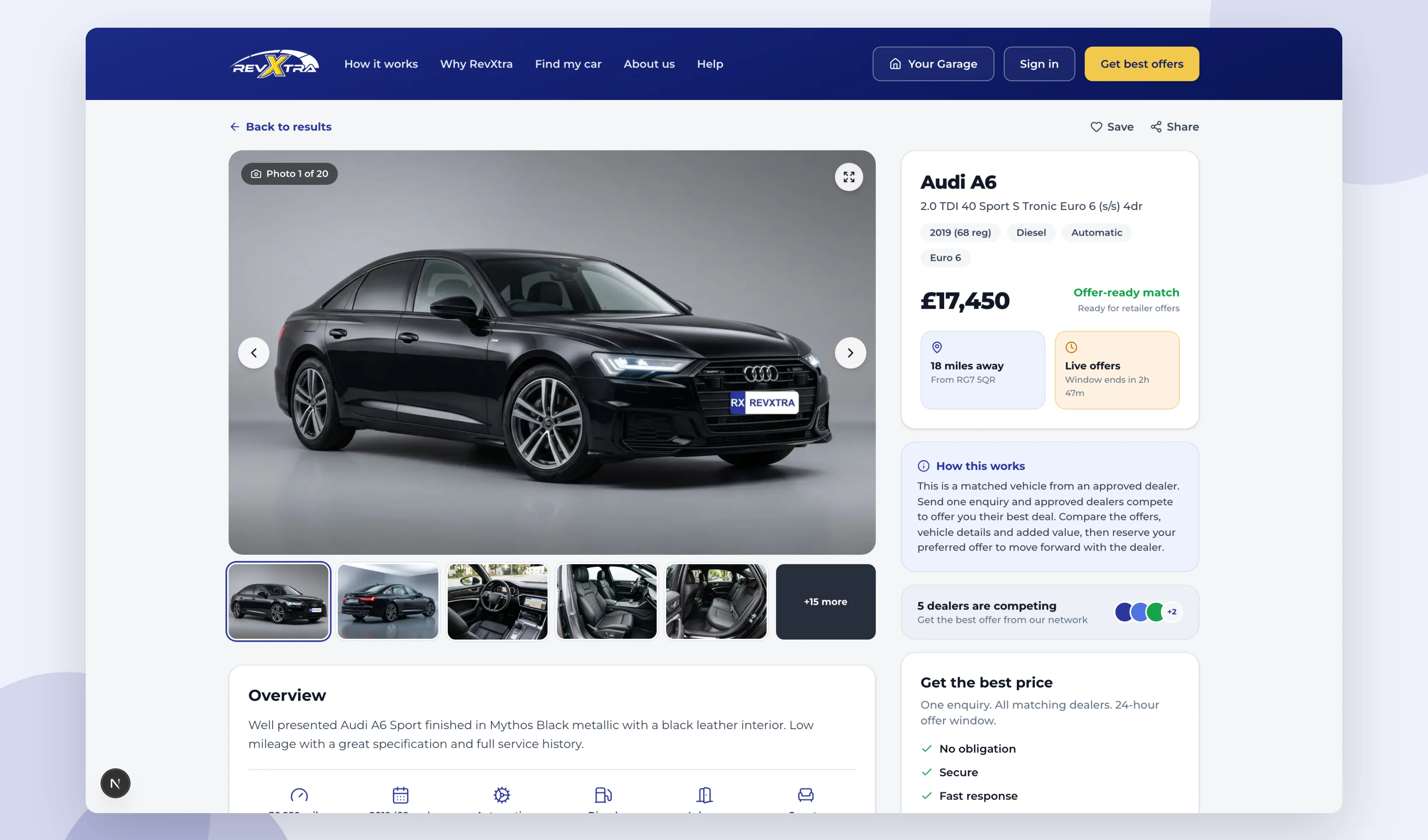
If most sessions are mobile, most hypotheses should start there. Sticky bars that cover CTAs, tap targets smaller than the accessible minimum, forms that zoom because inputs lack the right attributes, checkout steps that require landscape wrestling - these are conversion defects. Desktop-only heatmap conclusions are how teams ship “wins” that hurt the majority segment.
Findability on catalogues and marketplaces
On content-heavy and multi-vendor properties, IA and search are conversion infrastructure. Faceted navigation that lies, search that misses synonyms, category pages that dump hundreds of SKUs without ranking logic - people bounce not because the CTA colour is wrong but because they never reached a viable product. We’ve built 50+ marketplaces over 15+ years; the discovery lesson transfers: if search fails, checkout polish alone rarely recovers that session.
When the template and IA are the constraint rather than a fixable element, stop pretending CRO variants will save it. That is when a UX audit or a scoped redesign conversation is the honest next step - with cost context in redesign cost.
Testing without fooling yourself
A/B test results can mislead when:
- Sample sizes are tiny
- You peek daily and stop on a lucky spike
- Seasonality or a campaign coincides with the variant
- You test trivia while a broken form sits in production
Rules we follow: pre-register the hypothesis, decide minimum sample, avoid unplanned overlapping tests on the same funnel step or design an appropriate factorial experiment, and prefer ship-measure on obvious bugs over ritual testing. Qualitative evidence plus analytics often beats an underpowered test.
Pre-register the hypothesis
Write the change, the expected direction, the primary metric, the guardrail metrics (for example revenue per visitor, bounce on the step, error rate), and the minimum sample or runtime before you look. If you cannot state why the change should work in one paragraph, you are decorating, not testing. Agents can help draft the hypothesis card from a brief; a human signs it.
Sample size and peeking
Underpowered tests increase the risk of false or unstable conclusions. Repeated peeking with an opportunistic stop rule can inflate false-positive risk. Decide the stop rule up front. If traffic is too thin for a clean A/B on that template, ship the obvious fix, measure against a longer baseline, or gather qualitative evidence first. Pretending a week of sparse sessions is a randomised experiment wastes trust inside the business.
Seasonality, campaigns and overlapping tests
Black Friday, a PR spike, a sales email blast, or a tracking outage will swamp a weak effect. Unplanned overlapping tests can confound attribution unless the experiment is designed to estimate interactions. We serialise high-impact tests on a shared step and we annotate major traffic events on the timeline so nobody mistakenly attributes a campaign lift to a headline tweak.
Bugs are not variants
A form that fails on iOS Safari is not an A/B opportunity. Fix it, monitor error rates, and move on. Ritual testing culture that leaves known defects live while debating button labels is how CRO gets a bad name. Our bias: remove hard friction first, then test meaningful message and layout hypotheses with enough traffic to matter.
What “enough traffic to trust it” means in practice
Enough means the evidence is proportionate to the decision; a before-and-after comparison remains directional and does not by itself prove causation - not that you waited for academic purity. On a high-traffic paid landing page that might be a formal test. On a low-traffic B2B form it might be a careful before/after over a full sales cycle plus sales feedback on lead quality. The method scales; the tooling does not have to be identical.
We keep this discipline inside the same delivery system that ships maintenance: agents accelerate research and draft work, and seniors own what goes live.
A real CRO pass from our own work
We will not invent a fake “+47% overnight” case. What a typical Code23 CRO pass looks like in practice:
- Baseline the primary conversion and device split
- Fix hard friction first (form errors, speed, broken CTAs)
- Tighten message match on the highest-traffic landing template
- Add specific proof near the action
- Re-measure over a full business cycle, not three quiet days
When numbers are client-approved for public use they go through the claims register before we publish exact percentages. Until then, the method is the asset - and it is the method we run on client retainers and on our own properties.
How a pass actually runs week to week
Week of baseline. Confirm tracking integrity. Export the funnel for at least one full business cycle if history exists. Segment device and channel. List open technical defects that touch the path. Agree the primary metric and the guardrails with the client stakeholder who owns commercial outcomes - not only with the person who owns the CMS.
Hard friction first. Ship fixes for errors, speed cliffs and broken journeys. These are not experiments. They are defects. We verify in staging, release with human authority, and watch error and conversion charts for regressions. Agentic assistance speeds the implementation; release authority stays human - the same pattern we use across builds with a 90-day warranty on new project work and retainer care afterwards.
Message and proof on the money template. Once the path works, we improve the highest-traffic template that should convert: headline match to the acquisition promise, clearer primary CTA, proof moved next to the decision point, form shortened to fields that earn their keep. We change one coherent bundle when traffic is thin; we split tests when traffic can support it.
Re-measure properly. Compare like-for-like periods. Annotate campaigns. Check lead quality with sales or order quality with ops - a higher form rate that produces junk enquiries is not a win. If the template still cannot convert after friction and clarity work, we say so and discuss audit or redesign rather than selling endless weak variants.
Where CRO sits commercially
For most clients this work lives on Support & Growth at the public monthly tiers of £495 for Cyber Shield, £1,850 for Unlimited Growth and £3,450 for Pro Pod / Scale, with out-of-tier work priced before we do it. That is deliberate. Continuous repo access lets measured fixes ship quickly; a workshop is useful only when its recommendations are implemented. 350+ projects delivered since 2005, and the same senior-directed agent pattern we use in delivery: speed in the compressible work, judgement on what is worth shipping.
If AI-search visibility is part of how buyers find you before they hit the page, pair this operational CRO with the work in getting recommended by ChatGPT and Claude. Visibility without a working funnel wastes the click; a working funnel without visibility waits for demand you could have earned.
Frequently asked questions
How can you improve conversion rates?
Improve conversion rates by defining the conversion event, finding the biggest funnel leak, fixing friction (speed, forms, clarity, proof, mobile), and measuring with enough traffic to trust the result. Start with diagnosis; skip random homepage redesigns.
Is a 2.5% conversion rate good?
There is no universal good conversion rate, so a figure like 2.5% means little on its own. It might be a reasonable baseline for one funnel and weak for another, depending on the event, traffic mix and offer. Compare it against your own reliable baseline, not a single benchmark.
Is 12% conversion rate on a website good?
It depends entirely on the definition. A 12% rate cannot be judged without the conversion definition, page scope, traffic mix, offer and a dated comparable source. Confirm what “conversion” means and whether the figure is page-level or sitewide before drawing any conclusion.
Is a 20% conversion rate good?
Only relative to the page type and traffic quality. A 20% rate on a narrow, high-intent page (a demo request or pricing page) means something different from the same figure claimed sitewide. Any external benchmark needs a dated source and a matching definition.
What is a good conversion rate for websites?
There is no universal good conversion rate. Define the event and compare like-for-like by industry, offer, device, channel and funnel stage, using your own reliable baseline. Any external benchmark must name a dated source and use the same conversion definition. We help clients define both before comparing themselves to anyone else’s number.
How do you increase conversion rate on an ecommerce or Shopify store?
The same diagnostic order applies: fix broken checkout steps and slow pages first, then tighten category and search so buyers reach a product they want, then remove unnecessary account and form friction. Guest checkout with an optional account afterwards can remove account-creation friction; measure the effect. We’ve worked across WooCommerce, Shopify and custom builds, so the platform changes the tools, not the method.
Does conversion rate optimisation replace SEO or paid marketing?
No, they solve different problems. SEO and paid influence which visitors arrive and what they expect; CRO improves and measures what happens after the click. A working funnel with no visibility wastes the work of ranking well, and strong visibility with a weak funnel wastes the click. We run both together on client retainers so the two compound instead of competing for budget.
Next step
If your site gets traffic but the numbers feel soft, the fix is rarely a redesign. It’s finding the strongest evidence of where people give up, then shipping that fix in the codebase rather than a slide deck of hypotheses.
That’s what our Support & Growth retainer does: diagnose the funnel, fix the technical and message problems first, then test what’s left over with enough traffic to trust the result. With 350+ projects delivered since 2005, we hold client conversion work to the same standard.
Keep improving
Turn the next improvement into a measured release.
We’ll prioritise the work, ship it cleanly and measure what changes instead of letting the backlog gather dust.