What Is an AI Automation Agency (& Do You Need One)?
What AI automation agencies actually do, what the good ones charge, and the automation projects with measurable payback. From a UK agency that builds them.
What is an AI automation agency? It designs and ships systems intended to reduce repetitive work in real workflows, using models and agents under human-set rules. That’s what Code23 delivers under AI automation: a scoped project with a named owner and a monitored handover, not a demo, backed by 350+ projects delivered since 2005. An agency may be useful when a process has measurable cost, a clear exception path and insufficient internal delivery capacity. You don’t need one when you only want a homepage chatbot and a press release. Good automation work should leave you with monitoring, a named owner and a way to switch it off.
What the engagement usually covers
Typical delivery surface:
- Process mapping and data readiness
- Automation design (what the machine does vs what a human approves)
- Build and integration into the tools you already use
- Evaluation, logging, failure handling
- Handover and continuous engineering and Cyber Shield security
That sits next to, but is not identical to, AI consultancy (more advisory) and agentic AI development (the delivery pattern). Buyers searching this term often want measurable reductions in hours, cycle time or errors. They are not shopping for a model name.
Service hub: AI automation.
"James Ansell really knows his stuff... and goes over and above the call of duty in my opinion. He's done everything we've ever asked and more. … I would highly recommend James to anyone without a moment of hesitation."
What “automation” includes in 2026 (and what it does not)
Includes:
- Document intake and classification with human review on low confidence
- Quote and pricing assistants constrained by margin rules
- Support triage that routes, drafts and escalates
- Reporting packs assembled from trusted databases
- Content staging pipelines with mandatory editorial approval
- Internal agents that update tickets or CRM fields under permission
Does not include (unless separately scoped):
- Replacing your entire ops team in a quarter
- Unsupervised public social posting
- Autonomous refunds or legal commitments
- “AI strategy” with no pipeline
The boundary is boring on purpose. Boring boundaries are how automation survives contact with customers.
Buyers often describe desired outcomes using terms such as AI automation, workflow automation and business-process automation. Meet them there. Then translate into architecture without making them learn a framework catalogue first.
The market searches for automation outcomes, not development inputs
“AI automation agency”, “workflow automation” and “business process automation” describe the outcomes buyers often ask for, rather than development-input language. The commercial language is about time saved or reallocated.
What buyers actually ask on calls:
- Can you cut quoting time without breaking margin rules?
- Can you draft and route content without publishing unsupervised nonsense?
- Can you triage support so seniors only see exceptions?
- Can you reconcile documents against a source of truth?
What they rarely ask first:
- Which foundation model?
- Fine-tune vs RAG vs agents?
- Your preferred orchestration framework?
Good agencies translate outcomes into architecture. Weak ones open with model fashion and never name the workflow owner. If a pitch cannot say which role should save time, by when, and how that saving will be measured, keep shopping.
Adjacent category language - business process automation, AI workflow automation - maps to the same buyer intent with different vocabulary. The artefact is still a working pipeline with humans on the exception path.
Automation projects with measurable payback
We favour projects where payback is boring and measurable.
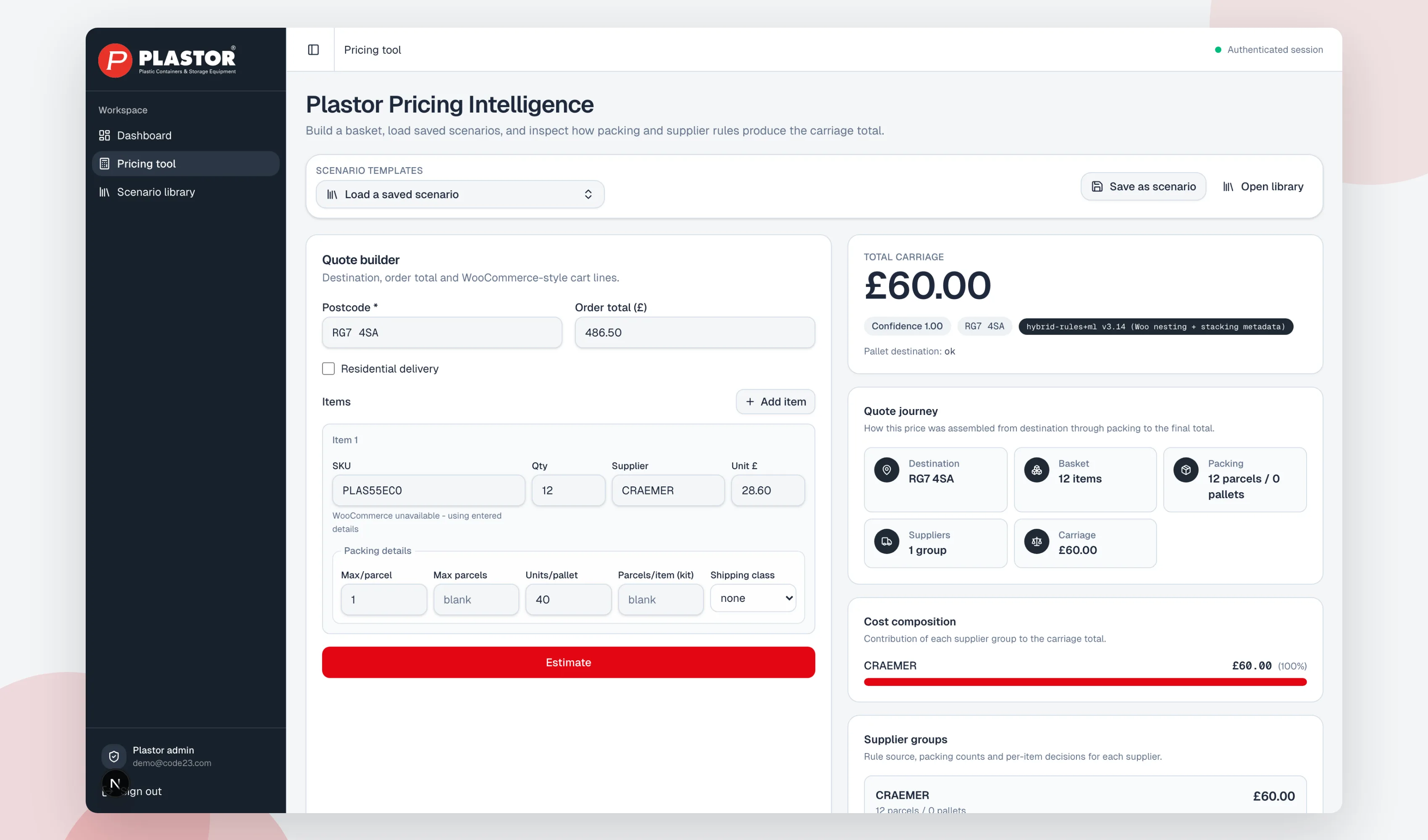
Logistics quoting (Plastor). A shipping-cost model trained on 13,371 historic orders. The point was not “we used ML”; the point was replacing a manual quote queue with an instant estimator that ops could run. That is automation with a commercial spine.
Content and SEO engines. Multi-agent pipelines that draft, check and stage - humans still approve what publishes. Useful when volume is the constraint and brand risk is managed with gates. A multi-agent content pipeline we run internally teaches the same lesson: agents draft, humans release.
Internal ops glue. Reporting packs, CRM hygiene, document compare (RAG-style tools in diligence-heavy domains), inbox triage. Potential value can be measured as hours saved for people who already know the business.
Agency delivery itself. Coding agents under senior direction are automation of implementation work. We measure that as AI-accelerated throughput on compressible implementation work; senior developers direct AI agents through that work, and scope, evidence and the agreed fixed quote determine price - method in the build-time data, qualitative trail in the build log.
Payback tests we use before build:
- How many hours per week does this process consume?
- What is the cost of a wrong automated action?
- Who owns exceptions at 4pm on a Friday?
- What data is clean enough to trust?
- What does success look like at the agreed review point - in a number someone already watches?
If (2) is existential and (3) is “nobody”, you are not ready. Automate a narrower slice. If (5) cannot be answered, you are buying a story. Stories do not repay invoices.
We also ask whether the workflow is politically contested. Automating a process two departments fight over does not dissolve the fight - it encodes it. Resolve ownership first, then encode.
What good automation work costs
There is no defensible universal UK band without a dated source and common scope. Quote an audit or prototype, production workflow or multi-workflow programme only after reviewing integrations, data quality, controls and handover. Code23 agrees a fixed price before build and prices changes before doing them.
Our approach: no build starts without a fixed price, and changes are priced before we do them. Senior developers direct AI agents through compressible implementation work; scope, evidence and the agreed fixed quote determine price. Continuous engineering and support can sit on Support & Growth tiers (£495 / £1,850 / £3,450) when you want us operating the boring parts. Advisory-only days are a different SKU - see the AI consultant cost piece.
Cheap automation that cannot be audited is expensive. Price evaluation and ownership into every quote or you risk paying for them later as emergencies.
Agency vs in-house vs no-code tools: honest decision guide
There is no moral hierarchy here - only fit. Teams waste money buying agency programmes for Zapier jobs, and they waste months pretending Zapier will replace a governed multi-step agent in a regulated workflow.
No-code tools (Zapier, Make, native SaaS AI features). Best for low-risk glue: notifications, simple enrichment, internal alerts. Weak when you need evaluation harnesses, complex permissions, or brand-critical publishing without a human gate.
In-house team. Best when automation is a standing product line and you can hire people who ship. Weak when you need production capacity sooner than the internal team can provide and your engineers are already underwater.
AI automation agency. Best when you want a scoped outcome with external pace, and you will assign a workflow owner on your side. Weak when nobody internally will own exceptions after launch.
Hybrid. Agency builds the first pipelines and harness; your team takes day-to-day; agency stays on a retainer for ongoing improvement. This can work when ownership transfers clearly. Hybrid also matches how we run Support & Growth after launch: keep the boring monitoring staffed so the win does not rot.
A practical sequencing we recommend: prove one workflow in production, measure hours returned, then expand. Parallelising five automations before any of them has an owner is how programmes become posters.
Consider agency help when several of these conditions apply; there is no fixed-count rule:
- The process costs real money every month
- Data is good enough or can be improved within an agreed preparation plan
- Leadership will kill sacred cows in the workflow
- You want production, not another innovation deck
Skip the category if you only need Copilot licences and training - that is enablement, not an automation agency engagement. Enablement can be valuable. It is still a different invoice, a different success metric and a different risk profile.
How to brief an automation agency without wasting a month
Bring:
- The workflow as it exists today (screenshots, SOPs, ugly spreadsheets welcome)
- Volume and time spent per week
- Systems of record and who owns admin access
- Examples of good and bad outcomes (especially the bad ones)
- Constraints: what must never be automated, what needs a human signature
- Success metric you will actually look at in week eight
Do not bring:
- A demand to “use the latest model”
- A requirement that no human ever touches exceptions
- A dataset you have never opened
- A transformation narrative with no owner on your side
A credible agency should narrow scope when the evidence and risk require it. That is a feature. Wide automation programmes without owners become slideware.
Security and data boundaries (non-negotiable)
Automation that touches customer data needs:
- Clear data classification (what can leave the VPC, what cannot)
- Audit logs of model and tool actions
- Red-team cases for prompt injection and tool abuse where agents browse or call tools
- Retention rules for prompts, outputs and embeddings
- A kill switch and rollback path
If the proposal is silent on those, the proposal leaves a material incident risk. We treat security hardening as part of delivery on AI features the same way we do on payments and accessibility - not as an optional upgrade after the demo lands.
When not to hire anyone yet
Wait if:
- The process changes every week because nobody owns it
- Leadership wants automation to avoid a management conversation
- Source data is fiction dressed as a CRM
- The only available metric is vanity (“number of AI initiatives”)
In those cases, fix ownership and data hygiene first. An agency can help diagnose; they cannot invent an operating model you refuse to staff. Since 2005 we would rather defer a project than automate chaos and call it innovation.
How this connects to agentic delivery
Some modern AI automation is agentic in the narrow sense: multi-step tool use under human rules; rules-based automation and RPA remain valid for deterministic workflows. The definitional framing lives in what is agentic AI. The commercial advisory framing lives in AI consultant cost. The build proof lives in logs and timing data. Use the words that match the cheque you want to write.
Start with hours, exceptions and data. End with a pipeline someone owns. Skip the middle fantasy where a model deletes your operating problems without changing how the team works. Automation that survives is often narrower than the first workshop suggested - and more valuable because of it. Narrow and live beats wide and theoretical in the projects we’ve run. Ship the thin slice, read the hours returned, then decide what deserves investment next.
350+ projects delivered since 2005: automation is more likely to pay back when it is boring, measured and owned.
That’s the shape we aim for through AI automation.
Frequently asked questions
What do AI automation agencies do?
They map costly workflows, build machine-assisted pipelines with human exception paths, integrate them into your stack, and leave monitoring and ownership behind so savings can be monitored and maintained.
What is an AI automation agency business?
It is a services business that sells outcome-based automation projects and often retainers - revenue comes from discovery, build, and ongoing optimisation rather than from shipping a single boxed product.
What is the best AI agent for automation?
There is no single best agent; the right stack depends on the workflow, data boundaries and review gates - pick tools after you name the process, not before.
How can I start an AI automation agency?
Learn one vertical’s painful workflows, ship paid pilots with ruthless scoping, publish proof with numbers, and productise delivery - the hard part is sales trust and ops ownership, not access to a model API.
How long does an AI automation project take?
It depends on the shape of the work. A workflow audit and thin prototype may be shorter than a production workflow, but there is no universal duration without seeing the process and integrations. A single production workflow, built, tested and handed over with monitoring, takes longer, and a multi-workflow programme longer still. We scope the timeline once we’ve seen the actual process, not before.
What’s the difference between AI automation and AI consultancy?
Automation is delivery: a working pipeline intended to reduce hours from a named workflow, with monitoring and ownership handed over at the end. AI consultancy is more advisory, helping you decide what to build and where the risk sits before anyone writes code. Some projects combine both; the sequence depends on what is already known.
Do I need clean data before I start?
Not perfect data, just data good enough to trust for the workflow in question, plus a plan to fix what isn’t. We’d rather use the early work to find out what your data can actually support than build on top of a spreadsheet nobody believes.
Next step
If a process on your team burns real hours every week and someone already owns fixing it, that’s worth a proper look. If nobody owns it yet, fix that first. We can help either way.
We’ve helped 50+ businesses implement AI. We’d rather scope one workflow properly than sell you a transformation programme nobody asked for.
Bring us the hours, the exception path and the system of record, and we’ll help you judge whether an agent belongs there.
Build with AI
Ship the product faster without cutting the quality.
Code23 combines senior engineering, AI-assisted delivery and proper testing to move complex products from idea to release.