What Does an AI Consultant Do (& What Do They Cost)?
What AI consultants actually deliver, UK day rates and project costs published, and how to tell a real AI consultancy from an agency that added AI to its site.
What does an AI consultant do, and what do they cost? A good one reduces uncertainty: they map your workflow and data, tell you straight whether AI is worth building for it, then either build the thing or hand you a clear no. UK day rates typically run £550-£1,200 for mid-level specialists and £1,500-£2,500 for senior ones, with focused projects starting around £15,000 and running into six figures for multi-system work. Those are market ranges, not a Code23 quote. We’re a web and product agency that ships AI inside real client systems, not a strategy house that talks about it, so how we price our own work is separate: a fixed price agreed before we start, with any changes priced before we make them.
The short answer: what AI consulting costs in the UK
| Engagement shape | Typical UK market range | What you usually get |
|---|---|---|
| Day-rate advisory | £550-£1,200/day mid; £1,500-£2,500/day senior | Workshops, architecture reviews, vendor selection, board packs |
| Focused project (discovery + prototype) | ~£15,000-£60,000 | Problem framing, data readiness, thin working slice, go/no-go |
| Production integration | ~£40,000-£150,000+ | Model/API wiring, evaluation harness, security review, handover |
| Multi-system / regulated programme | £150,000-£500,000+ (and up) | Multiple workflows, compliance overhead, change management |
Independents and boutiques often sit toward the lower-middle of those bands; large consulting houses and MBB-style AI practices sit at the top. Hourly equivalents in public 2026 guides commonly span roughly £150-£350+ for independents through much higher for big firms - useful as a cross-check when someone quotes only a day rate.
How we price our own AI work is separate and corpus-bound: a fixed price agreed before build starts, any changes priced before we do them, agentic delivery framed as AI-accelerated delivery and roughly half the cost of a traditional bench for comparable implementation. Support after launch sits on public tiers of £495 / £1,850 / £3,450 for continuous product growth and zero-liability Cyber Shield protection. Do not confuse market averages with a Code23 quote - ask us to scope it first.
Related commercial terms: AI automation agency when you want outcomes automation rather than advice alone, and AI development company when you need a build shop rather than a pure consultant.
What an AI consultant actually delivers
A useful AI consultant reduces uncertainty and leaves you with working software or a clear kill decision - not a 60-page PDF that restates your own workshop notes.
Discovery that hurts (in a good way). Data quality, process owners, failure modes, and where a model or agent cannot be trusted unsupervised. If discovery never says “no”, it was sales.
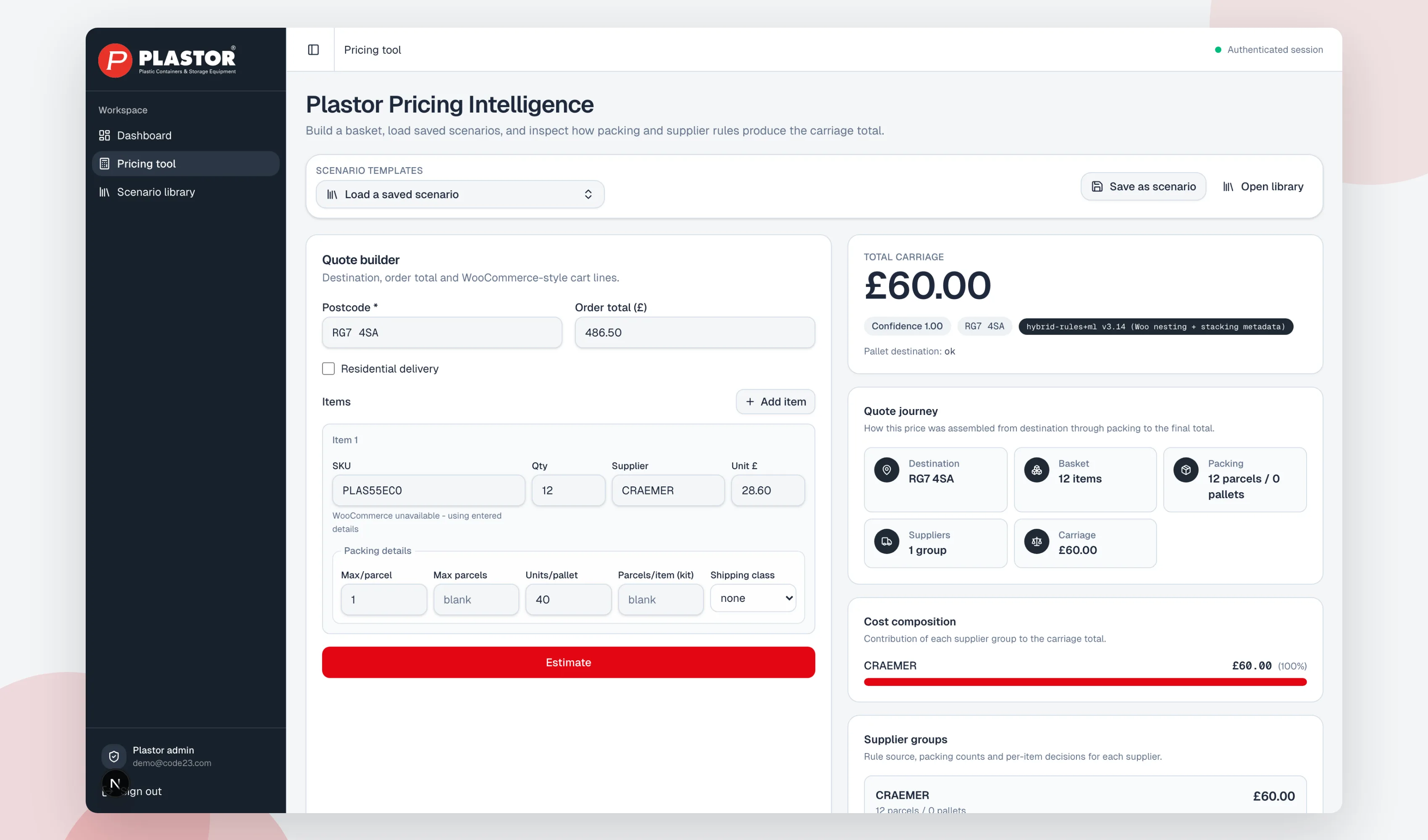
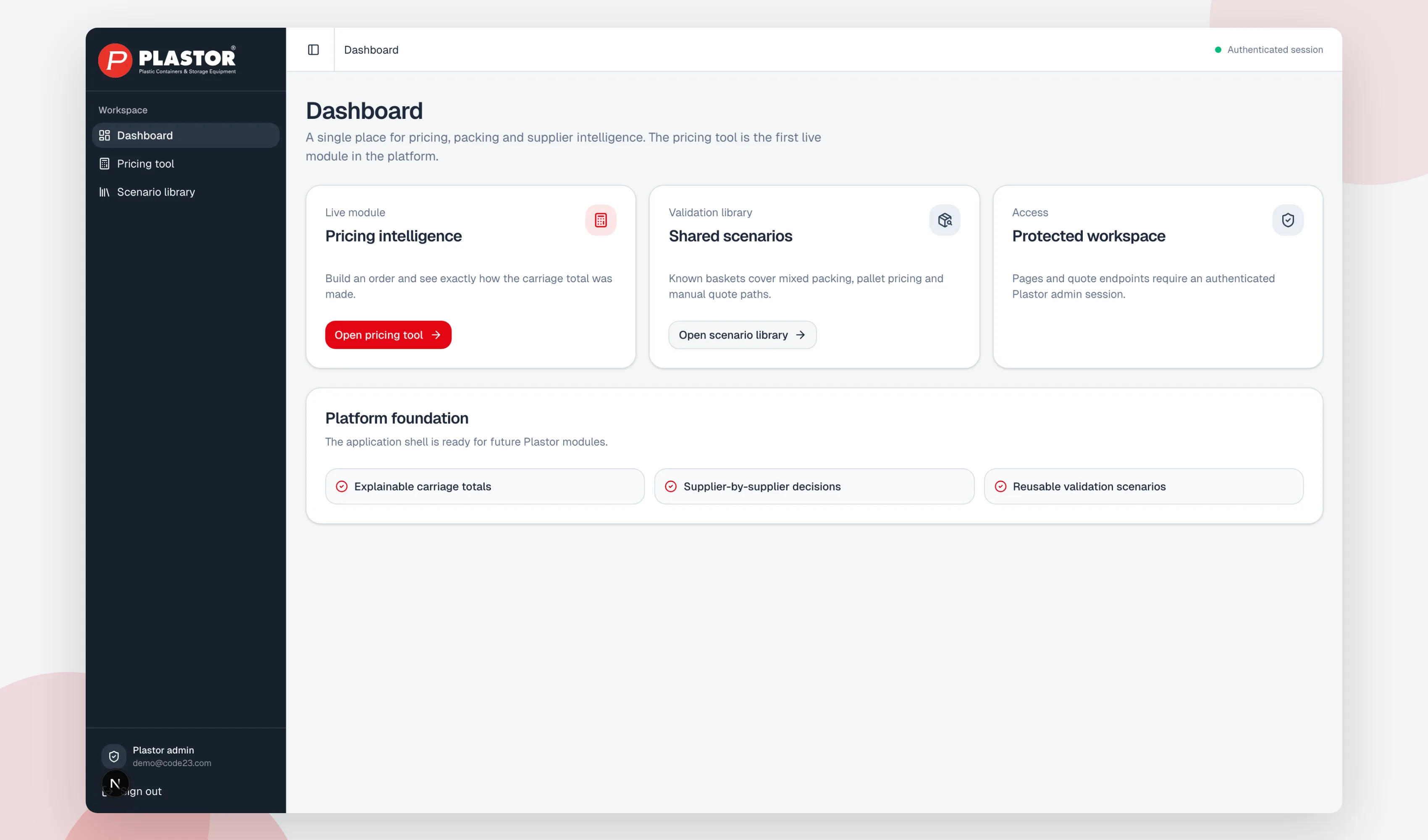
Build and integration. Wiring models or agents into real systems: ERP, CRM, CMS, logistics tools, internal ops. Evaluation harnesses, logging, human review gates. The Plastor shipping-cost model trained on 13,371 historic orders is the kind of artefact we mean - production ML against real order history, not a chatbot demo on the marketing site.
RAG and retrieval products. Document-heavy workflows where answers must cite sources. VDR-style compare tools sit here: retrieval plus judgement, with humans still owning release.
Enablement without abandonment. Runbooks, evaluation checklists, and who to call when the model drifts. Handover is part of delivery.
What is not consulting:
- Relabelling your existing web team as “AI” because they used Copilot once
- A slide deck of use cases with no data assessment
- An unsupervised agent dropped into customer support with no escalation path
If the engagement cannot name the system that will change and the metric that will move, keep the chequebook closed.
Small business vs enterprise budgets
Small UK businesses often need a narrow win: one workflow, one dataset, one owner. A £15,000-£40,000 slice that proves value beats a strategy programme that never ships. Copilot licences plus training may be enough if the pain is personal productivity rather than system change.
Mid-market usually lands in fixed projects: integrate a model or agent into an existing stack, add evaluation, train the team, leave monitoring. Budget conversation starts with the workflow hours saved, not with model fashion.
Enterprise pays for governance as much as for models: security review, procurement, data residency, change management, multiple stakeholders. Day rates climb; calendars stretch. If your RFP asks for “AI transformation” with no named process, expect expensive fog.
Across all three, the expensive mistake is identical: buying a show before the data is ready. Shipping software since 2005 taught us that lesson before models entered the chat - AI just makes the demo look better.
Consultant vs consultancy vs AI development company: which you need
Independent AI consultant. Best when you need senior judgement for a short window: vendor selection, architecture challenge, board education. Weak when you need a multi-disciplinary team for months.
AI consultancy. A firm selling advisory and sometimes delivery. Good when change management and stakeholder work dominate. Watch for partners who outsource all build and disappear at integration time. Our AI consultancy route covers readiness, governance and go / no-go work with a shipping handoff.
AI development company / product engineering partner. Best when the outcome is software in production. You still want AI literacy, but the commercial shape is a build: Map, Discovery Sprint, Build, Harden, Launch. That lives under AI development.
Automation-first agency. When the buyer language is “remove this manual process”, not “advise us on AI strategy”. See what an AI automation agency is.
Rough decision rule:
- Need a decision and a thin proof → consultant / short consultancy sprint
- Need a production feature with owners → development partner
- Need ops hours deleted every week → automation engagement with a payback model
Many UK buyers search “AI consultancy” when they actually need a build. That search volume is real, and it’s why we keep the advisory detail on our AI consultancy page separate from this cost breakdown: one page for what the market charges, one for what we’d actually do for you.
How to spot AI-washing
Scan the UK agencies ranking for AI and web terms and a pattern emerges: disclosure of how AI is used in their own delivery is close to non-existent. A few make unevidenced speed claims. Almost nobody publishes build logs, review gates or failure notes.
Buyer checks that expose washing:
- Ask who merges production code. If the answer is “the AI”, walk.
- Ask for a review trail. Diffs, test failures, human release authority.
- Ask what stayed slow. Honest teams name discovery politics, content freezes and third-party waits. Fantasists claim everything 10x’d.
- Ask for a proof artefact. Model cards, evaluation sets, a build log, or method notes like our build-time data.
- Ask where humans remain accountable. Agentic delivery means humans lead and agents execute inside remit - see what is agentic AI.
- Check entity consistency. Firms that cannot keep their own description straight rarely keep your model governance straight.
- Listen for corpus-free numbers. Invented “average ROI” without method is perfume.
- Probe data rights. Who owns fine-tunes, prompts, logs and derived datasets?
- Probe failure policy. What happens when the agent is confidently wrong?
- Separate marketing site toys from client production. A homepage chatbot is not a logistics model.
- Compare the invoice shape. Pure workshops billed like transformations are a smell; so are “AI transformations” with no Harden phase.
AI-washing thrives because buyers are scared of missing out. Fear is not a scope document.
What are the top AI consultancy companies in the UK?
“Top” lists are usually assembled from directories, sponsorship, affiliate relationships and editorial packages - not from a shared quality audit - so use them as a lead list, then apply the disclosure checks above rather than treating the ranking as proof.
What are the 10 best AI consulting firms?
There is no stable, objective top-10 that survives a change of directory or sponsor; shortlist firms that publish method, name human release authority, and show production artefacts, then run references in your sector.
What “good” discovery produces
If you hire a consultant for two or four weeks, the artefacts should be usable without the consultant in the room.
Minimum useful pack:
- A workflow map with owners, systems and failure modes
- A data readiness note (what is clean, what is missing, what must never leave the building)
- A shortlist of automation or model opportunities ranked by payback and risk
- A list of ideas you should not fund
- A thin prototype or evaluation harness when the claim needs proof
- A commercial recommendation: stop, advisory-only, or progress to a build Blueprint
If discovery only produces slides that restate your workshop sticky notes, you bought facilitation, not consulting.
Budget honesty: a £15,000-£40,000 discovery that prevents a £200,000 wrong build is cheap. A £40,000 discovery that always concludes “you need a large transformation” deserves a second opinion.
"He has taken the time to understand both the commercial and technical requirements, communicated clearly throughout, and delivered a well-thought-out system with a high level of flexibility. The admin dashboard, in particular, gives us full control over the scoring and valuation logic, which was a key requirement."
Day rates vs fixed projects vs retainers
Day rates suit uncertain scopes and board-level advisory. Cap the days. Demand a written outcome for each block.
Fixed projects suit defined builds and integrations. Insist on acceptance criteria and a Harden phase. This is where our Blueprint-then-fixed-band model sits.
Retainers suit ongoing evaluation, prompt/ops maintenance and small Evolve work after something is live. Do not buy a retainer to hide an undefined transformation.
Mixed models work when labelled. Mixed models fail when “advisory” quietly becomes unpaid product management for an offshore build team you never meet.
What an engagement with us looks like
We are a web and product agency that ships AI inside real client systems - est 2005, 350+ projects - not a pure-play strategy house that never merges code.
Shape. Map the workflow and data. Blueprint a fixed commercial band for build-shaped work. Build with seniors directing agents. Harden (evaluation, security, accessibility where UI exists, failure modes). Launch. Evolve under support if you want us to stay.
Proof styles we already run.
- Logistics ML against 13,371 historic orders (Plastor)
- RAG / compare-style products in document-heavy domains
- Agent-assisted delivery across websites, marketplaces and SaaS at the AI-accelerated / half-cost framing we publish with method
Commercial mechanics on builds. A fixed price agreed before build starts; any changes priced before we do them; 90-day warranty on project work; optional Support & Growth retainers at £495 / £1,850 / £3,450.
What we refuse. Unsupervised agents in production, vanity chat widgets sold as transformation, and claims we cannot source.
Worked shapes (anonymised pattern, not invented metrics).
- A logistics client with historic order data ready for modelling - production ML against 13,371 orders, evaluated against the incumbent quote path, humans still owning exceptions
- A document-heavy product needing retrieval and compare - RAG with citations, evaluation set, release gates
- An internal content pipeline - agents draft and check, humans publish, monitoring on failure modes
Each shape started with a workflow and a dataset, not with “add AI somewhere”. That sequencing is the difference between consultancy and costume jewellery.
When comparing three proposals, ignore the logo strip and line up: day rate or fixed price, what is in Harden, who merges, data rights, warranty, and whether the team will still answer the phone when the model drifts. Trust signals help; the review trail on a live engagement is the proof.
How much does an AI consultant cost?
In the UK, expect roughly £550-£2,500 per day depending on seniority and city, or project fees from about £15,000 for a focused slice into six figures for production programmes - always confirm what is advisory versus build.
What do AI consultants get paid?
Independent specialists typically bill clients the day rates above; employed consultant salaries sit lower and vary by firm, while partners at large houses earn through utilisation and firm economics rather than a simple day-rate take-home.
Frequently asked questions
What happens in an AI consultation session?
A good session starts with your workflow, not a slide deck: what’s slow, who owns the decision, and what data actually exists. Ours end with a straight answer - build it, don’t, or come back once the data’s ready - plus a note of what a working prototype would need. If a session ends in vague enthusiasm rather than a decision, you’ve had a sales call, not a consultation.
What’s the difference between AI consultation and AI development?
Consultation is the decision: is this worth building, and what would it need? Development is the build: the model or agent wired into your systems, tested and handed over. We run both under one roof, so the same team that scopes the problem is accountable for shipping it, rather than handing you to a different supplier once the slide deck’s approved.
What should be in an AI consultant’s contract?
Look for a fixed price or a capped day count, a named testing phase before launch, who owns the code and any fine-tuned model, data rights over prompts and logs, and a warranty on defects. If the contract only covers advice with no acceptance criteria for a build, get that written down separately before you sign.
What does an AI evaluation consultant check?
An evaluation consultant tests whether a model or agent is reliable enough to trust with real decisions: accuracy against real cases, failure modes, and where a human still needs to check the answer. It’s the step that separates a working system from a demo that only performs well on the cases it was shown. Ask for the evaluation set, not just the headline accuracy number.
Next step
If you’re comparing AI quotes right now, don’t start with the day rate. Start with the workflow, the data behind it, and who owns the outcome when it doesn’t work first time.
We’re a build partner as much as an advisor. Discovery that ends in a working prototype or a clear no, a fixed price agreed before we start, and a named person who still answers the phone when the model drifts. We’ve helped 50+ businesses implement AI, and we’ll tell you straight whether a consultant, a build partner or nothing at all is what you actually need.
Bring us the workflow and the data. We’ll bring the discovery, the fixed price and the people who are still around after launch.
Get cost certainty
Get a fixed price before the build starts.
We’ll discuss what you need, then get back to you with a clear price and timescale within 48 hours.