What Makes a Niche Marketplace Work?
When a niche marketplace can outperform a horizontal one, how to assess liquidity, and what real niche builds can teach us about the build decision.
What makes a niche marketplace work? A focused market with a clear user problem, reachable supply and demand, and unit economics suited to its revenue model, not a homepage that looks like a mini-Amazon. Code23 has built marketplaces across cosmetics, parenting, funerals, vans, sponsorship, kids’ parties and pubs, and the same lesson keeps repeating: horizontal platforms rely on broad scale, while vertical marketplaces may differentiate through specialised discovery, language and trust controls inside a single trade.
That’s still the test in 2026. Software cannot prove demand by itself, but it can reduce friction where supply and demand already exist, so the vertical has to earn that first, before anyone opens a code editor.
This guide covers the liquidity test that helps you judge whether a vertical can sustain a marketplace, what real niche builds have taught us, and the warning signs that mean you should wait before you fund one.
What a niche marketplace is, and when vertical can compete with horizontal
What is a niche marketplace?
A niche marketplace is a two-sided (or multi-sided) platform focused on one category, profession, geography or use case - practitioners and clients in aesthetics, venues and fans for football pubs, fleet owners and renters for commercial vans - rather than a general catalogue of everything. Matching, search filters, compliance and trust signals are tuned to that vertical. The product speaks the trade’s language.
Horizontal platforms still dominate broad retail. Vertical marketplaces may compete better where:
- Buyers need specialised filters Amazon-style search cannot express cleanly
- Sellers need category-specific onboarding and credibility
- Trust and regulation differ from general ecommerce
- Community density matters more than infinite SKU count
Shipping that niche portfolio taught us the blunt version: breadth feels ambitious in a pitch deck. Vertical focus can support more relevant discovery and trust controls, but each market still needs evidence of demand, supply and workable economics. Full sequencing of a build sits in how to develop a marketplace; commercial ranges in marketplace build cost.
The liquidity test: how to tell if a vertical can sustain a marketplace
Liquidity means buyers find enough quality supply, and sellers get enough demand, often enough that both sides return. Software can reduce friction; it does not establish demand or supply by itself.
Run this test before you fund a build:
- Can you name a cohort of sellers who would list next month with a spreadsheet and a WhatsApp group?
- Is the transaction repeatable (or high enough value) to fund acquisition on both sides?
- Does the vertical already have fragmented discovery - directories, Facebook groups, brokers - you can improve?
- Will sellers accept a clear fee once you add trust, payouts and demand?
- Are category boundaries tight enough that the catalogue does not rot into junk?
If those answers are soft, a niche is a wish. Stronger answers identify what to test next; they do not decide the build alone. Revenue mechanics that sit on top of liquidity are covered in how marketplaces make money.
How do you find a niche for a marketplace?
Start from pain you can witness, not from a blank “billion dollar category” brainstorm. Look for fragmented supply, repeated matchmaking already happening offline, and language outsiders get wrong. Interview sellers about how they find work today and what they hate about it. Deprioritise categories where a dominant horizontal platform already owns trust and logistics, unless evidence supports a defensible wedge they structurally cannot serve.
Vertical lessons from builds we shipped
What is an example of a niche marketplace?
Documented examples:
| Marketplace | Vertical | Documented product pattern |
|---|---|---|
| Costhetix | Aesthetics marketplace | Practitioner onboarding, profiles, search and messaging make credibility visible |
| Sponsorfy | Football sponsorship | Boards, hospitality, programme and kit are listed as priced assets with availability |
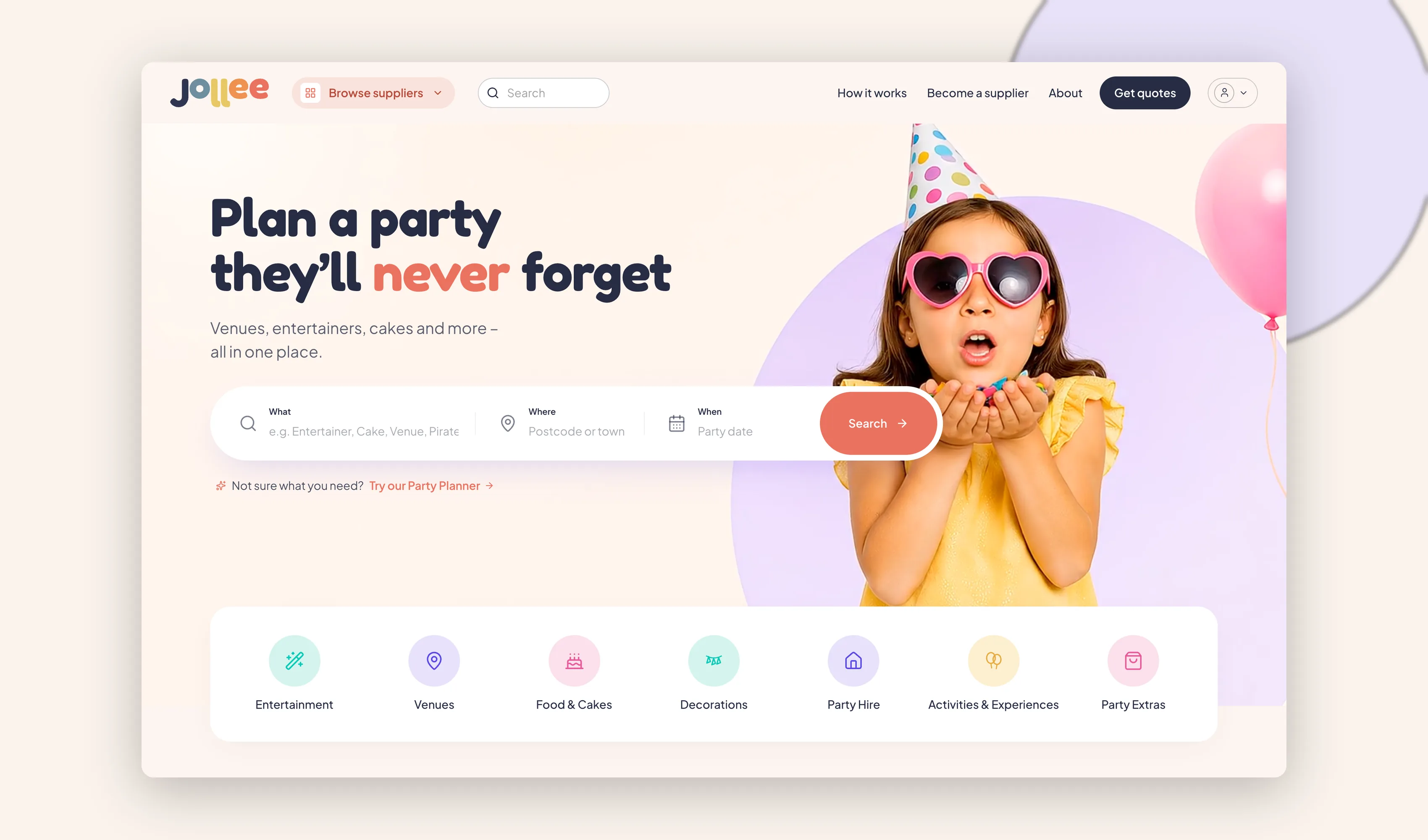
| Jollee | Kids’ parties | Parents search by service, location and date across category-specific suppliers |

Are niche marketplaces profitable?
They can be, when density and unit economics work, not because the vertical sounds romantic. Profitability depends on transaction frequency and value, take rate, acquisition costs, support and operations. Thin niches with one-off purchases and heavy support struggle even with beautiful apps. Build and launch work gives us product context, but it doesn’t prove a client’s unit economics unless those results are shared with us. Honest downsides sit in marketplace disadvantages.
"After wanting to up my game with my marketplace website I found Code23. They made switching web agencies really easy and have consistently provided great support, thoughtful suggestions and advice to improve the website thats has helped me focus on growing the business. The team are super responsive which is very reassuring for a non-techie!"
Signs your niche is too small (and what to do instead)
Warning signs we treat as serious:
- You cannot recruit a first supply cohort without the product
- Your unit economics can’t support the acquisition and operating model you actually plan, once fees are accounted for
- Sellers already have a default channel they will not leave for a small convenience gain
- The category needs licences or logistics you cannot intermediate yet
- Search demand exists but willingness to pay a platform fee does not
Alternatives when the marketplace shape is wrong:
- A strong directory plus lead fees (simpler, still useful)
- SaaS tools for one side only (sell software, not liquidity)
- A managed service or agency model that uses software internally
- Delay the platform until manual matchmaking proves volume
Investor interest does not establish marketplace liquidity; test supply and demand before funding the platform. Manual matchmaking that already works can provide evidence before you build, though it doesn’t guarantee the marketplace will survive.
From idea to validated niche: the discovery process we run
We do not start in Figma. We map the commercial loop: who sells, who buys, what “good” inventory is, how money moves, and what leakage looks like when parties try to cut you out. Discovery workshops pressure-test the niche with real seller conversations and a liquidity sketch before anyone prices a full build - the productised entry is our product discovery workshop.
Only then lock payments, onboarding and the MVP cut on paper. Agent-assisted implementation can reduce some delivery work, but it does not create supply or demand. After launch, change fees and category rules from live ops - the same discipline we use on platforms we help launch.
Frequently asked questions
How is a niche marketplace different from a niche directory?
A directory primarily lists suppliers and may charge for listings or leads. A marketplace supports more of the matching, booking or transaction journey, and payment may happen on or off platform depending on the model. Directories can be simpler to operate and may provide an earlier test of the market, and they’re a sensible way to prove a vertical before you build software around it. We’d only recommend the marketplace step once you can show repeatable transactions the directory can’t capture on its own.
How many sellers do you need before you launch a niche marketplace?
There’s no fixed number. Test whether a reachable cohort will commit to listing and participating before launch; the quality and relevance of that commitment matter more than a raw total. We test this in discovery before pricing any build: real seller conversations, not a target headcount pulled from a pitch deck.
Can a niche marketplace grow into a horizontal one later?
Sometimes, but it’s not the plan to start with. Expansion can work, but each adjacent category needs its own demand, supply and operations case; there’s no universal sequence for adding verticals. Start narrow, prove the model, and let expansion follow evidence rather than ambition.
Next step
If you’re weighing up a niche marketplace, don’t start by drawing the database schema. Start by running the liquidity test in this article on paper: named sellers, a repeatable transaction and a fee they’ll actually tolerate. Software removes friction from a trade that’s already close to working by hand. It doesn’t create a market that isn’t there yet.
Our free Marketplace Growth Review is a 30-minute call that helps you judge whether the liquidity evidence supports a build, a directory or more manual testing. The scored liquidity test against your real numbers is part of the paid Growth Plan below. We’ve built 50+ marketplaces over 15+ years, across categories from aesthetics to funerals to football sponsorship, giving us practical context for pressure-testing a niche. The free review helps you judge which assumptions to test next. If the honest answer is “not yet”, we’ll tell you that too, and point you at a directory or a manual process instead.
Marketplace Growth Review
Help judge whether the problem is worth solving
- A 30-minute call about your marketplace idea or platform
- Help you judge which assumptions to test next
- Liquidity test scored against your real numbers
- Buyer, seller and admin journeys reviewed
- Category pages, search and take-rate modelling
- Competitor and adjacent-vertical scan
- AI search visibility check
- A 90-day plan
- A fixed build price
Marketplace Growth Plan
What to fix, what to build and what it costs, in writing
- Liquidity test scored against your real numbers
- Buyer, seller and admin journeys reviewed
- Category pages, search and take-rate modelling
- Competitor and adjacent-vertical scan
- AI search visibility check: whether ChatGPT and Google's AI answers already mention anyone in your vertical
- A 90-day plan
- A fixed build price
- A written plan you can take to your board or investors
If the pattern fits, we’ll bring the same liquidity thinking to your build from day one, not bolt it on after launch.
Build the marketplace
Start with the workflows that make the model work.
We’ll map buyers, sellers, payments and operations before the build, backed by experience from more than 50 marketplace projects.